Combining Regions
There are a few ways to combine any two Region objects
into a compound region, i.e., a CompoundPixelRegion,
CompoundSkyRegion, or CompoundSphericalSkyRegion object.
Let’s start by defining two sky regions:
>>> from astropy.coordinates import Angle, SkyCoord
>>> from regions import CircleSkyRegion

>>> circle1 = CircleSkyRegion(
...    center=SkyCoord(1, 2, unit='deg', frame='galactic'),
...    radius=Angle('5 deg'))
>>> circle2 = CircleSkyRegion(
...    center=SkyCoord(-4, 3, unit='deg', frame='galactic'),
...    radius=Angle('3 deg'))
Intersection (AND)
To create an intersection compound region, use either the & operator
or the intersection() method:
>>> comp_region = circle1 & circle2
>>> print(comp_region)
Region: CompoundSkyRegion
region1: Region: CircleSkyRegion
center: <SkyCoord (Galactic): (l, b) in deg
    (1., 2.)>
radius: 5.0 deg
region2: Region: CircleSkyRegion
center: <SkyCoord (Galactic): (l, b) in deg
    (356., 3.)>
radius: 3.0 deg
operator: <built-in function and_>

>>> comp_region = circle1.intersection(circle2)
>>> print(comp_region)
Region: CompoundSkyRegion
region1: Region: CircleSkyRegion
center: <SkyCoord (Galactic): (l, b) in deg
    (1., 2.)>
radius: 5.0 deg
region2: Region: CircleSkyRegion
center: <SkyCoord (Galactic): (l, b) in deg
    (356., 3.)>
radius: 3.0 deg
operator: <built-in function and_>
Union (OR)
To create a union compound region, use either the | operator or the
union() method:
>>> comp_region = circle1 | circle2
>>> print(comp_region)
Region: CompoundSkyRegion
region1: Region: CircleSkyRegion
center: <SkyCoord (Galactic): (l, b) in deg
    (1., 2.)>
radius: 5.0 deg
region2: Region: CircleSkyRegion
center: <SkyCoord (Galactic): (l, b) in deg
    (356., 3.)>
radius: 3.0 deg
operator: <built-in function or_>

>>> comp_region = circle1.union(circle2)
>>> print(comp_region)
Region: CompoundSkyRegion
region1: Region: CircleSkyRegion
center: <SkyCoord (Galactic): (l, b) in deg
    (1., 2.)>
radius: 5.0 deg
region2: Region: CircleSkyRegion
center: <SkyCoord (Galactic): (l, b) in deg
    (356., 3.)>
radius: 3.0 deg
operator: <built-in function or_>
Symmetric Difference (XOR)
To create a symmetric difference compound region, use either the ^
operator or the symmetric_difference() method:
>>> comp_region = circle1 ^ circle2
>>> print(comp_region)
Region: CompoundSkyRegion
region1: Region: CircleSkyRegion
center: <SkyCoord (Galactic): (l, b) in deg
    (1., 2.)>
radius: 5.0 deg
region2: Region: CircleSkyRegion
center: <SkyCoord (Galactic): (l, b) in deg
    (356., 3.)>
radius: 3.0 deg
operator: <built-in function xor>

>>> comp_region = circle1.symmetric_difference(circle2)
>>> print(comp_region)
Region: CompoundSkyRegion
region1: Region: CircleSkyRegion
center: <SkyCoord (Galactic): (l, b) in deg
    (1., 2.)>
radius: 5.0 deg
region2: Region: CircleSkyRegion
center: <SkyCoord (Galactic): (l, b) in deg
    (356., 3.)>
radius: 3.0 deg
operator: <built-in function xor>
Example Illustrating Compound Regions
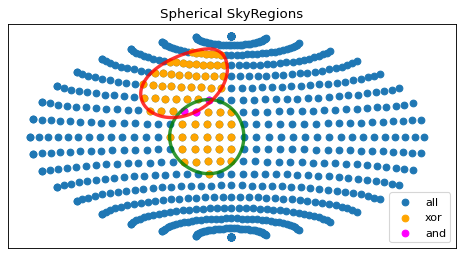
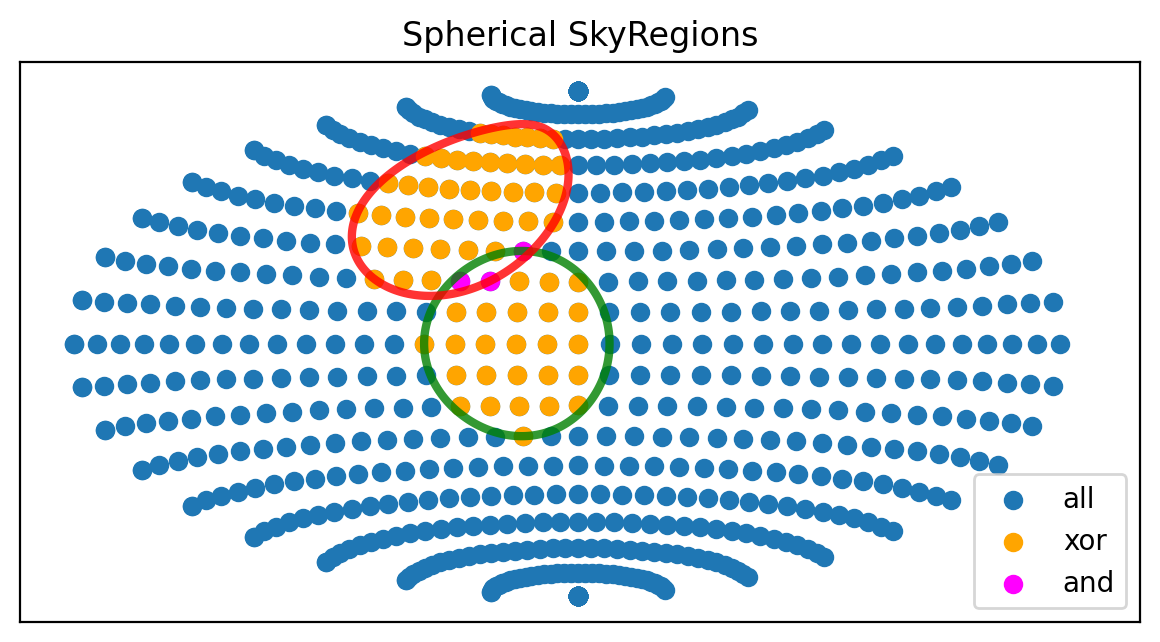
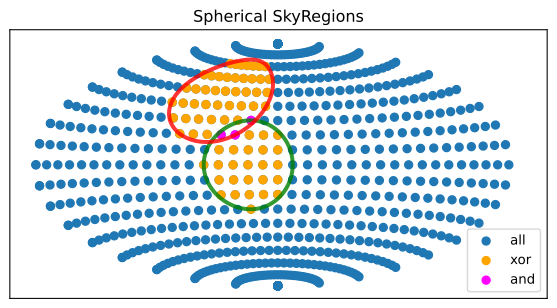
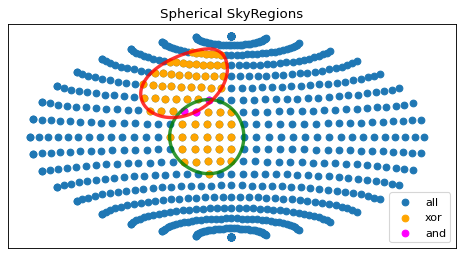
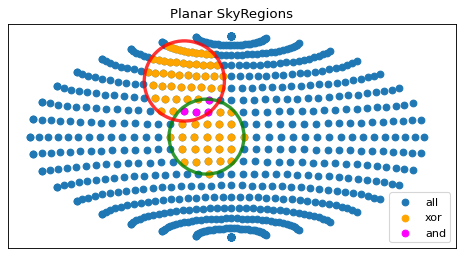
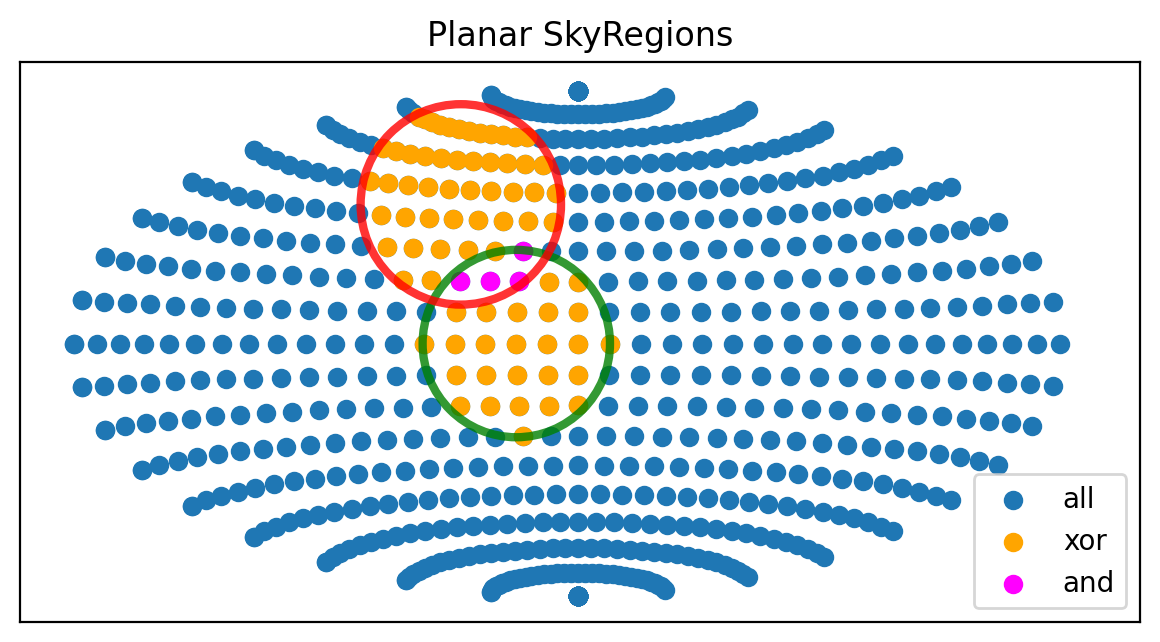
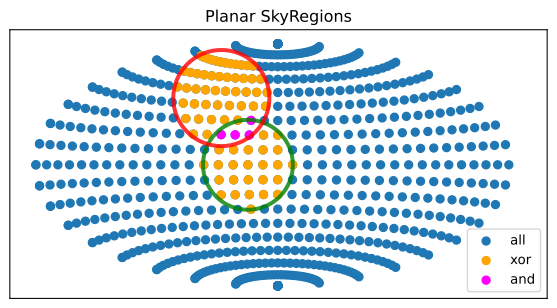
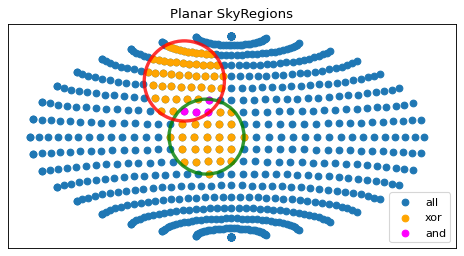
The following examples demonstrate how to combine planar sky regions and spherical sky regions, with the same circle centers and radii.
(Source code, png, hires.png, pdf, svg)
(Source code, png, hires.png, pdf, svg)